
Janenne Eaton - Artist
  • HOME
  • ESSAYS
  • EXHIBITIONS
  • BOOK
  • MULTI MEDIA
  • NEWS
  • BIO-CV
  • CONTACT

EXHIBITION ESSAYS & ARTICLES
Picture

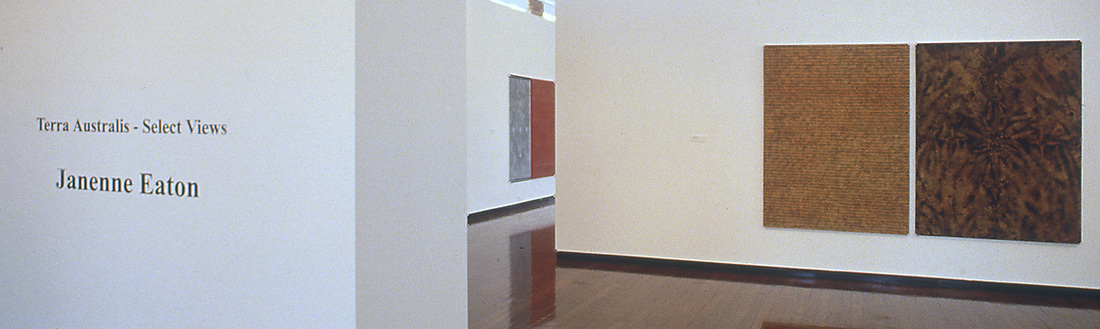
Exhibition: Terra Australis 1996 - The Penal Colony Series
ANU Drill Hall Gallery, Canberra
                
- exert from review:
New Visions from an old landscape, Sonia Barron, Canberra Times, September 1996


The Penal Colony Series
 
Quoted in an article by Lynn Magor-Blatch, in the current Print Council Publication. Imprint, the artist says: “ By shifting the vision away from the original ‘scenic’ or ‘factual’ descriptions and emphasizing these marginal pictorial elements, I am attempting to suggest a narrative that both calls up the sensations and reveals a sense of the real life experience of the people during the early days of white settlement.  Critical to the language of the works is their reference to the imposition of the ‘patterns’ of an alien culture on to that of the indigenous inhabitants and their land.  The images explore this violent mapping of terrain, the collision of cultures and the bloody history of well-regulated penal servitude”.

First it must be said that these are quite beautiful paintings.  Visually seduced, we are drawn in by their patterns and optical effects.  In some works Eaton has used sand and fibre glass mesh and, in one diptych, a panel of embroidered fabric.  In each instance these components are fundamental to the ideas and perceptions we are asked to consider.

A prime recurrent pictorial element, the broad arrow insignia that embellished convict uniforms is repeated across a brilliant yellow field, the colour of convict clothing, in Yellow Jacket – afterimage.  In At Parramatta, the broad arrow is superimposed on a wave-like field of folds.

Beyond the more general reference to our convict past there is also the underlying idea of convict labour in general and more specifically to women’s work.  The arrow is also present in 5040 Maryannes – the name given to female convict servants – but here it is transformed into a subtle pink pattern comparable to a dress fabric.

Terra Australis is a major diptych in which the imposition of order on the land is implied in the left-hand panel consisting of horizontal black and ochre linear patterns and in the right panel by the stamp of the British Museum, familiar from many early botanical and topographical studies, superimposed in a row down an image of densely ordered ferns.

Other references may be found to the ways in which Aboriginal artists depicted landscape and in the right panel you may find an allusion, as I did, to Victorian fabric design yet the inclusion of the broad arrow of the convict suggests another more despairing perception of the land.

Eaton’s abstraction of land-space into horizontal patterns can also take on different contexts as in Australia Felix, the name given to the fertile land south of the Murray River by Thomas Mitchell in 1836, and in the lustrous black reflective surface of Screens and reflections – the Never Never.

While Eaton’s art has become more focused on real historical issues, rather than on the the more universal conundrums of human existence that once occupied her, this is an intellectually stimulating group of works that questions our preconceived notions of the past and succeeds in opening up a dialogue on many levels.

We can thank Nancy Sever for curating this stunning exhibition and the art historian Charles Green, who puts Eaton into art historical and philosophical context in his essay for the catalogue, which has been superbly designed by Petr Herel.

-exert from review, New Visions from an old landscape, Sonia Barron, Canberra Times, September 1996.

Janenne Eaton © 2025