
Janenne Eaton - Artist
  • HOME
  • ESSAYS
  • EXHIBITIONS
  • BOOK
  • MULTI MEDIA
  • NEWS
  • BIO-CV
  • CONTACT

EXHIBITION ESSAYS & ARTICLES
Picture
Exhibition Catalogue 2008

Recovering Lives

Picture

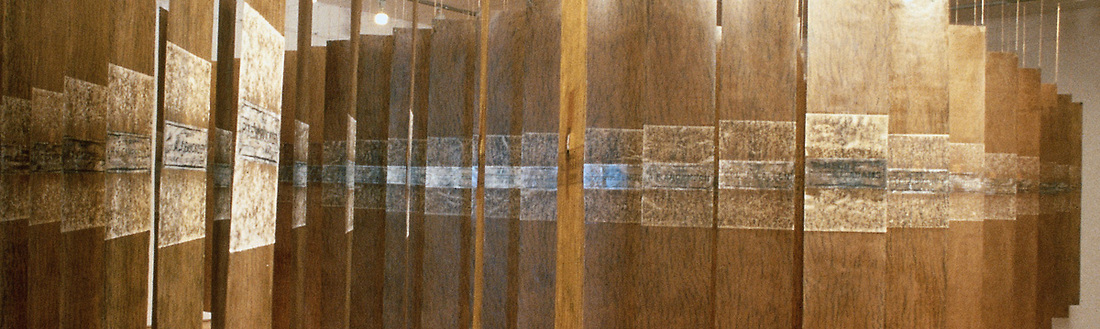
Exhibition: The Avenue of Honour – anatomy of a monument 
Australian Centre for Contemporary Art, Melbourne 1995
Shrine of Remembrance, Melbourne 2007
ANU Drill Hall Gallery, Canberra 2008

Each tree stands as a silent sentry representing a gallant soldier. The trees are protected by well-made timber guards, affixed to each of which is a neat sheet-copper embossed name plate, giving the soldier’s name rank and Battalion.  The soldiers have been placed in alphabetical order and numbered, placing the members of one family together.
                                                                                                 -  Bacchus Marsh Express 17 August 1918

 
The Bacchus Marsh Avenue of Honour – Anatomy of a monument.
  
While travelling through the Bacchus Marsh Avenue of Honour at dusk in late winter 1992, 
I was struck by its symmetry and stark, doleful grandeur.  As the last watery light of the day illuminated the commemorative name-plaques affixed to each tree, and deepened the black lattice of the rain-soaked branches against the sky, it’s history and place in the landscape seemed equally illuminated.  As a WWI memorial it had clearly survived the passage of time; to flourish into an imposing and significant settler cultural artefact. The slow drive through its 2.9 km length brought home the realization that those responsible for its original planting on the 17th of August 1918, would have done so knowing that they would not live to see it reach its mature beauty.  I was also reminded of my grandfather, Gordon Eaton, who survived the trenches on the battlefields of France.
 
In 1992 I had begun work on a new project – the Penal Colony series - an undertaking prompted by the facts and stories I was learning about the lives of my forebears and their place in Australia’s colonial history.  My interest to explore the story behind the Avenue of Honour’s position in this landscape was sparked by the recognition of its significance as an enduring and distinctive cultural marker; an historical artefact in harmony with the distinct surroundings characteristic of an Australian colonial settler landscape. Stretching from the eastern Otway coasts and shores of Port Phillip Bay to the central Victoria uplands, this luxuriant terrain, nurtured and cared for over thousands of years by its traditional owners the Wadawurrong People, now measured, cut, cleared and fenced according to the classical patterns of an alien world order. My family history also has connections to these lands. In 1840 my three times Great Grandfather Domenico Sonsi, a mariner, left his home in Venice to settle in Ballarat, Victoria. 
 
As I began to follow up on my initial interest with some research into the Avenue’s story, a larger and more complex narrative emerged; one composed of many layers.  Initially, an understanding of the monument’s history was generously aided by members of the Bacchus Marsh community.  Documents and contemporaneous newspapers were made available to me at the local historical society; individual members of the community to whom I spoke were happy to share their memories, spanning decades, of living with the Avenue as part of their daily lives.
 
As an artist with a background in archaeology, I recognized that the Bacchus Marsh Avenue of Honour offered the potential, and a rare opportunity, to undertake a cross-disciplinary approach to the making of an artwork. My strategy for imagining what form an artwork might ultimately ‘resolve as’, was to begin by employing basic archaeological site recording processes. The artistic possibilities inherent in this approach gradually emerged via the repetition of the necessary tasks I undertook to record particular aspects and characteristics of the monument’s ‘anatomy’– the bones of it.  Ultimately, the formal language of the work evolved through time and a multitude of processes consistent with both art making and with site survey methods used in field archaeology: description, notation, visual recording, and ‘retrieval’.  In this case, ‘archaeological retrieval’ became ‘artistic process’.  Ultimately, my conceptualisation was for the work to function simultaneously as an installation-based artwork and as a ‘documentary text’ of the Avenue as it stood in 1993.
I felt encouraged that the Bacchus Marsh community took an interest in my project as it evolved. On several occasions reporters from the local newspapers came out to take photos and to report on my work progress. It always seemed to be on a windy day!
 
Reflecting on what I learned of the Avenue’s back story at various stages of the project and some of those things that I observed as I worked along the Avenue, certain aspects stood out that not only appealed to me but kept me going as I came to grips with the physical scale of the project itself.
 
Clearly, the survival of the Bacchus Marsh Avenue of Honour has depended on a past century of careful curation and practical maintenance by the entire community.  I learned of some initiatives that arose at different times which would have destroyed or spoiled the integrity of the monument had the people of the town not stood up to protect it.  Seen by some as a traffic hazard to be removed; and others as an impediment to new developments; other stresses: drought, arboreal diseases and now climate change, has so far failed to diminish its durability.
 
Testament to the Avenue’s significance within the district as a repository of cultural and historical memory and meaning became clear to me as I met each tree along its route. I noted the formal variations of commemorative plaques which indicated periodic action through the past century to replace those that went missing or had been damaged. Others I found carefully attached to low posts beside a young tree planted to replace the original.  I never once encountered a tree or a new planting that did not have a plaque.
 
      - Janenne Eaton 2000 


Janenne Eaton © 2025